
Christopher Nolan's ET

There’s some weird stuff in The Odyssey but, then again, it’s a weird story. My daughter and I went to see the movie last night after I mistakenly assured her that there was no need to buy advance tickets as nobody would be in a little Connecticut movie theater on a Tuesday night. In fact, it was packed. That alone was weird. Who even goes to the movies anymore? Apparently, I do.
Of the casting controversy around Lupita Nyong’o as Helen of Troy, that’s among the least strange choices. To me, the oddest was casting Tom Holland as Telemachus. Why cast a 30-year-old very publicly married to one of your other co-stars as the 20-year-old, inexperienced son of Odysseus? I thought Charlize Theron and Anne Hathaway should have switched parts. John Leguizamo’s Nuyorican accent pulled me out the story. Elliot Page is underutilized.
Matt Damon is terrific in that Matt Damon way of his; as his career developed, the closest comparison is Harrison Ford, who perfected the role of everyman hero. Damon’s “I’m scared but doing the right thing” face is on full-display throughout.
As for the movie itself, it’s also strange. I guess that tracks considering the age of the source material, and Nolan struggles hard to make it appeal to modern sensibilities. I think he mostly succeeds; the film is good popcorn fare.
The battles and monsters and Trojan Horse stuff are all familiar Hollywood tropes, which one probably should have if one is spending $400M on a movie. And, at its heart, the movie follows the classic 3 act story structure: reluctant hero struggles to return home. In this way, The Odyssey is no different than ET.
Where it diverges is in its non-linear sequencing and in its themes, the two of which are related. Ever since Memento, Christopher Nolan has been making films about the relationships between memory, time, and the world’s hidden nature. The Odyssey also plays with these themes and adds a philosophical musing about the nature of sacrifice. The result is an intellectual – even meditative – action movie.
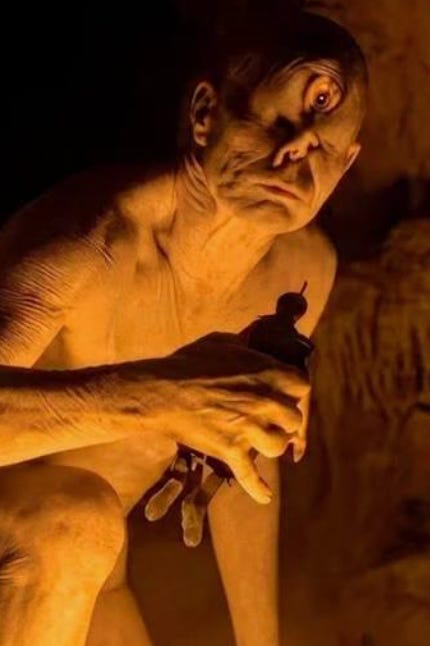
At times, that means the movie struggles to maintain its pace. Also, there’s something almost gauzy about it, as if the movie itself is a memory of another. Maybe that’s another result of the source material, but it kept me at a certain remove from the experience which, again, feels like a Nolan hallmark. Oppenheimer, too, left me appreciative but unmoved. That film suffered, perhaps, from its heady subject matter, but The Odyssey has the same problem even though there’s nothing particularly heady about a fifty-foot, one-eyed, man-eating monster or the fall of Troy.
It’s like Nolan has a preoccupation with the head of humanity but can’t quite find his way into its heart. Is that why his films are overwhelmingly male? Is it why his two most memorable characters are Heather Ledger’s Joker and Tom Hardy’s Bane? Both are animated by feeling in a way Nolan’s heroes often aren’t; both are about transforming the suffering of one into the suffering of many. Both, therefore, begin from a place of emotion rather than intellect, unique among Christopher Nolan characters. And it’s probably not a coincidence that both began life as comic book creations, whose rock ‘em, sock ‘em nature complements Nolan’s more ethereal leanings.
Which is also why, as beautiful as Oppenheimer is, that film suffers from a similar bloodlessness as The Odyssey. It’s hard to get too much blood pumping in a story about physics. Like Oppenheimer, I imagine The Odyssey will get nominated for a slew of awards, although, like Oppenheimer, I’m not sure it deserves to win any of them. Don’t misunderstand – The Odyssey is a very good film. Enjoyable and thought-provoking. But for all of its bloodletting, it feels curiously bloodless. Nobody’s walking out humming the tunes, if that makes any sense.
The thing is, I like over-intellectualizing stuff. It’s basically my whole thing, man. So I support Nolan and all his good works. I appreciate that he seems to care what his movies are about as much as how they look. I love that he takes big swings with unusual source material and that those big swings mostly work.
We need more Christopher Nolans out there proving that people will show up for well-told, smart tales, even if the story being told is 3,000 years old. As ever, I’m just grateful for people making the kind of art only they can make. Nobody else could have made this version of The Odyssey. Nobody else would have even thought to try. The movie is absolutely worth watching, although like all of Christopher Nolan’s movies, I doubt I will ever watch it again.
I typically agree with your insightful writing and accurate presentation of the world we inhabit. This post is no different with one exception: watching any Nolan film only once is bad form. I find Memento, The Prestige and Inception only get better with repeated viewings.
I felt depleted after watching it. Granted I had not studied Homer since my senior undergrad year which was 50 years ago. The story has been retold many different times in modern settings. I guess I got it. Guess being the operative word. It was a cinematic feat. No doubt about that. And I am glad I saw it. But, the ancient Greeks were an odd lot. Their legends, myths and religion were so barbaric and fantastical. Sometimes I find it strange to think a culture which gave use Socrates, Aristotle and Plato gave us crazy gods as well.
Great review, Michael. Thank you.